
Bounded cases
Exercise Aurora against externally supplied assurance questions, operational boundaries and systems, producing evidence about both technical capability and delivery value.
Development pathway
With Aurora, Codance has already built the working evidential substrate. The next development programme subjects it to independent technical challenge, exercises it against bounded real-world assurance problems, turns repeated learning into deployable product capability and advances the assurance methods it can support.
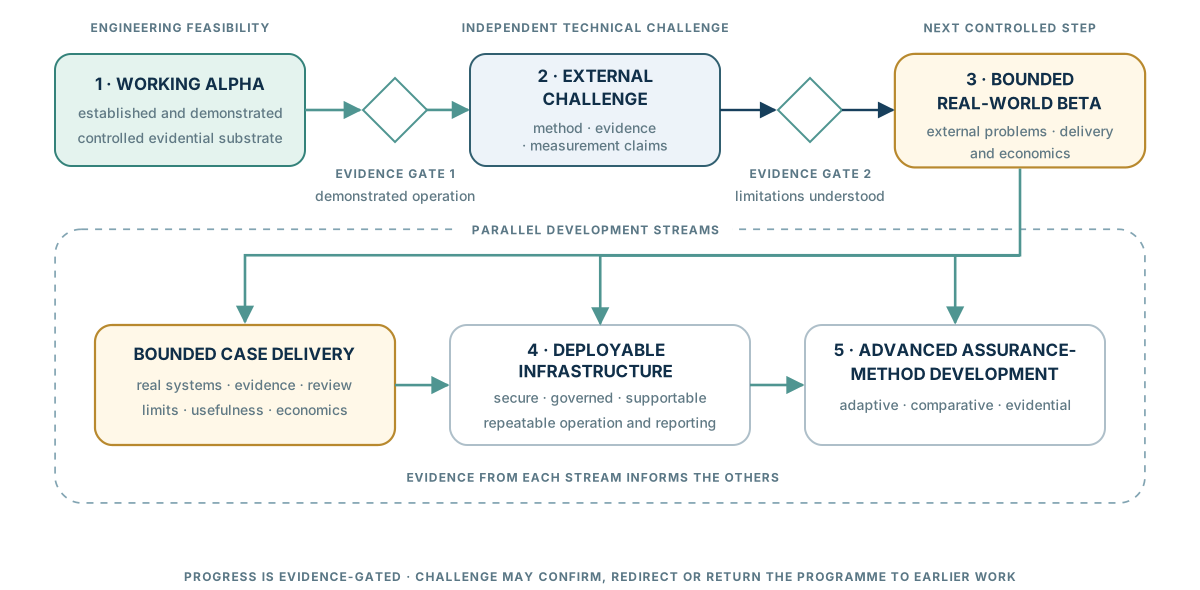
Development is evidence-gated, not calendar-gated. Each stage advances when evidence supports the next level of claim, deployment or use. External challenge or operational experience may confirm assumptions, expose limitations or require earlier work to be revisited.
Establish that controlled execution, evidential attribution and reverse reconstruction can operate together as an end-to-end engineering foundation.
Expose the engineering hypothesis, apparatus, evidential claims, measurement assumptions and reporting to competent independent challenge.
Apply Aurora to assurance questions, systems and boundaries Codance did not invent; test decision usefulness, delivery repeatability, integration and economics.
Turn proven engineering capability into secure, governed and supportable method authoring, campaign operation, evidence review, reporting and deployment.
Aurora already provides the architecture for highly adaptive, comparative and event-driven methods. The continuing pathway develops and tests increasingly sophisticated method compositions against real cases, using evidence to determine where those capabilities add value while preserving attribution, reconstruction and legitimate human authority.
Parallel development
From the first bounded beta, Aurora stops developing as a linear product roadmap. External cases expose limitations; product engineering converts repeated needs into controlled capability; method development tests richer forms of assurance against the same evidential discipline.
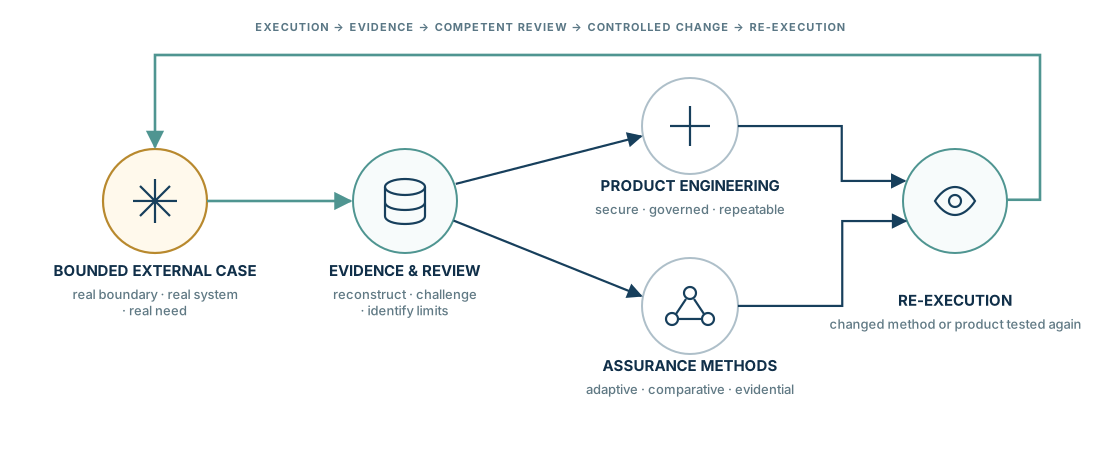
Exercise Aurora against externally supplied assurance questions, operational boundaries and systems, producing evidence about both technical capability and delivery value.
Turn recurring operational needs into secure, governed, supportable interfaces, reusable campaign structures and repeatable operating practice.
Aurora already contains the architectural capability for rich adaptive, deterministic–probabilistic and model-comparative methods. The work is to mature their composition and use against real evidence while preserving evidential discipline and legitimate human authority.
Execution → evidence → competent review → identified limitation → controlled improvement → re-execution.
The emphasis is method maturation, not feature accumulation. Increasingly sophisticated assurance comes from disciplined composition and use of capabilities already present in Aurora, informed by evidence from real cases.
Programme dependencies
Real assurance boundaries, domain authority, independent technical challenge, representative systems and operational use cases cannot all be self-supplied without weakening the test. Aurora is designed to receive those inputs; the development programme depends upon them.
Competent parties provide real risks, criteria, constraints and the authority under which an assurance question is meaningful.
External expertise tests the method, evidence, measurement claims and assumptions rather than treating Codance's own assessment as sufficient.
Test environments and applications broaden the evidence beyond the originating demonstrator and expose integration and observability realities.
Real delivery constraints, user needs, economics and review practices reveal what must become repeatable product capability.
External participation broadens and strengthens the test; it is not sought as a badge. The objective is competent challenge and better evidence, not borrowed endorsement.
What investment accelerates
Codance is inviting aligned investment to provide the capacity and runway required to progress Aurora through independent challenge, bounded beta use, productisation and continued method research. Capital provides runway and engineering capacity; relevant expertise, market access and suitable test environments provide conditions that capital alone cannot create.
| Contribution | Value to the programme |
|---|---|
| Financial resources | Engineering capacity, beta delivery, productisation, governance, security and controlled commercial development. |
| Market access | Suitable design partners, sectors, channels and early customers with consequential agentic use cases. |
| Technical & assurance expertise | Independent challenge of methods, evidence, measurement claims, deployment assumptions and reporting. |
| Test environments | Representative systems in which Aurora can be exercised beyond its originating demonstrator. |
| Domain knowledge & authority | Relevant risks, declared boundaries, acceptance criteria, operational realities and competent review requirements. |
| Strategic relationships | Connections to professional bodies, research institutions, regulators, integrators and future distribution partners. |
Conditions for success
Codance must earn a sustainable position through technical credibility, commercial relevance, repeatability, delivery economics, institutional development, IP discipline and focused market competence.
Demonstrations and beta campaigns withstand competent reconstruction, challenge and criticism.
Outputs materially support deployment, risk, quality or governance decisions rather than merely producing technically interesting evidence.
Campaigns, methods and integrations become progressively reusable rather than remaining bespoke founder exercises.
Cost, speed and support burden permit a viable specialist assurance business without sacrificing evidential discipline.
Knowledge and operation expand beyond the founder into controlled product, documentation, governance and team capability.
Codance protects the platform while respecting partner methods, customer evidence and confidential operating context.
Development is not measured by feature count. It is measured by the strength of the claims that evidence allows Aurora responsibly to support.